Define
Process sequence, safe states, operating modes, users, and responsibility boundaries.
ENGINEERING RESOURCES
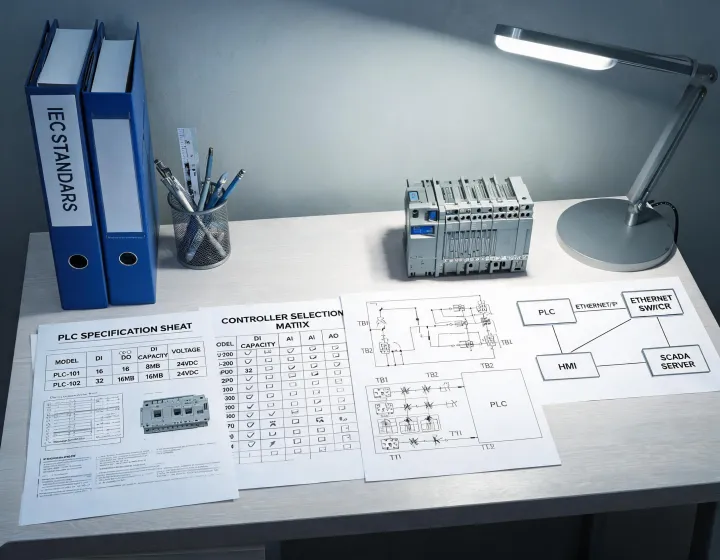
Move from application boundary to electrical ratings, controller capacity, I/O topology, communications, compliance, and commissioning checks. These resources are working aids; current manufacturer documentation for the exact catalog number remains the controlling source.
Process sequence, safe states, operating modes, users, and responsibility boundaries.
Digital, analog, specialty, safety, and spare I/O by location and update demand.
EtherNet/IP, Modbus TCP, switches, addressing, segmentation, and gateway ownership.
24 V DC supply, ambient range, IP or NEMA enclosure, and installation clearances.
Firmware, software, accessory, certification, and target-market applicability.
Power-up, I/O checkout, network loss, backup, recovery, and acceptance evidence.
Records controller family, memory, task load, local capacity, expansion allowance, power supply, environment, and software baseline.
Separates digital, analog, specialty, safety, and spare points while documenting isolation, terminal, and update requirements.
Distinguishes device, cell, and plant networks, with managed-switch functions, address ownership, and failure behavior.
Captures test environment, method, observed result, and reproducible step for power, I/O, communication, and recovery checks.
Centralized versus distributed control: centralized design can make strategy and data governance more direct; distributed control can improve local autonomy and fault isolation. Compare network dependence, maintenance skills, cabinet distribution, commissioning ownership, and recovery requirements.
Utilization versus derating margin: compact high-utilization designs can reduce initial footprint, while conservative margin can improve thermal performance and accommodate future I/O. Base the decision on ambient temperature, ventilation, measured load, expected expansion, and outage consequence.
Verification boundary: a bench simulation can reproduce controller logic, I/O forcing, network interruption, and backup recovery, but cannot fully reproduce field grounding, electromagnetic interference, connected loads, or operator practice. Repeat critical acceptance tests at the installed system.
Authority names indicate where applicable evidence may originate. They do not assert that every listed product carries every mark.
Send your completed selection sheet or the raw drawings. We will identify missing assumptions, compatibility questions, and documentation needed before quotation.
Submit Engineering Documents